Where Is The Ownership Breaking? — KwanHoward.com
CourageConsistencyAwarenessAbilityAgreement
Where Is The Ownership Breaking?

Find Out What's Keeping Your Stores
From Running Like Your Best One.

In 5 minutes, identify what’s getting in the way of consistent execution — and what to address first.

At your best store, things get handled. The GM follows through. Standards hold. Problems get solved. You don't have to keep checking whether yesterday's conversation turned into action.

Then there are the other stores.

You've explained what needs to happen. You've followed up. You've reminded them. They said they understood.

And somehow, you're still having the same conversation.

Before you push harder, find out what's actually breaking down.

The Say It Once Diagnostic identifies where execution is most likely breaking — Courage, Consistency, Awareness, Ability, or Agreement — so you know what to address first.
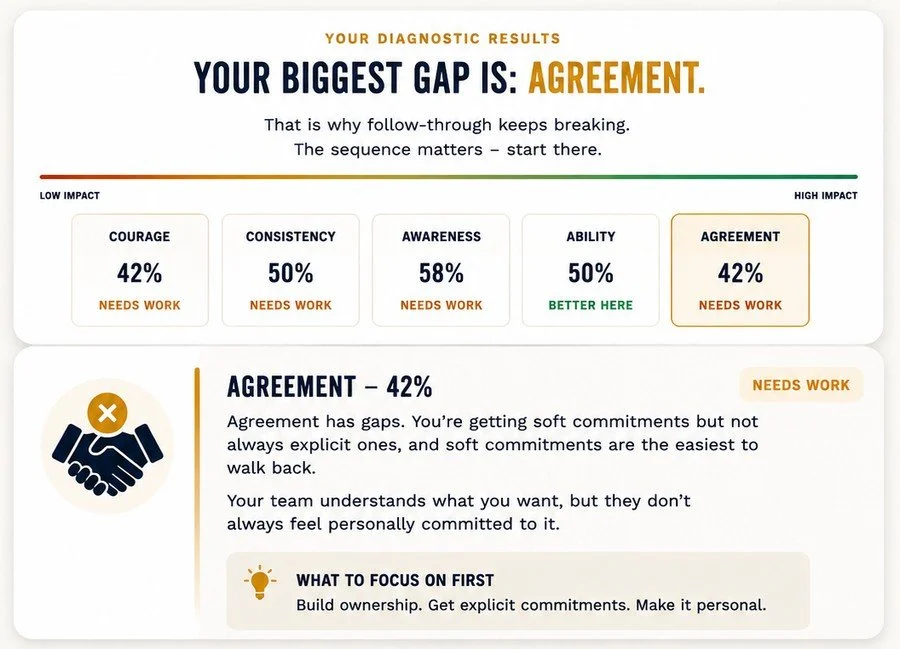
Sample Say It Once Diagnostic result showing scores across Courage, Consistency, Awareness, Ability, and Agreement, with Agreement flagged as the biggest gap.
Sample result
Built for District Managers who want their managers to run the store the way they would — without having to be there.
20
Questions
5
Minutes
Free
Always
Before You Answer — Read This.

Answer every question based on what is actually happening in your stores right now — not what should be happening, what you've already communicated, or what happens when you're standing in the building.

Think about:
  • The managers you find yourself chasing most.
  • The expectations you keep repeating.
  • The commitments you keep following up on.
  • And the stores that seem to require more of you than they should.
Garbage in, garbage out. The goal isn't a good score. It's finding the right thing to fix.

“It worked like a charm. And not only did it work — it was easy. It’s usually like pulling teeth for me to get people to do stuff. That was so easy.”

— Restaurant Operator
Takes about 5 minutes. Get your breakdown and the first place to intervene.
C1
Section 1 of 5
Courage — The Left Rail
Are you actually addressing the breakdowns that need to be addressed?
When someone misses a standard, deadline, handoff, or commitment, how quickly do you typically address it?
Answer required
When a conversation gets uncomfortable or the other person pushes back, what typically happens?
Answer required
Think about a recurring issue you haven't fully addressed. How long has it been going on?
Answer required
After a difficult accountability conversation, what best describes how you feel?
Answer required
Consistency — The Right Rail
C2
Section 2 of 5
Consistency — The Right Rail
Does your environment support or undermine the standard?
When someone hits the standard or follows through well, what typically happens?
Answer required
How consistently do you follow up after an accountability conversation?
Answer required
How would the people you depend on describe the consistency of your expectations week to week?
Answer required
When you've let a standard slide once, what usually happens next?
Answer required
Awareness — Rung One
A1
Section 3 of 5
Awareness — Rung One
Do people actually know what done looks like?
If you asked the person responsible to explain the standard, handoff, or commitment in their own words, what would happen?
Answer required
When you communicate a standard, how do you confirm they received it clearly?
Answer required
When someone says "I didn't know that was the expectation," what's most likely true?
Answer required
How specific are the standards you communicate to your team?
Answer required
Ability — Rung Two
A2
Section 4 of 5
Ability — Rung Two
Can they actually do what you are asking?
Before holding someone accountable, how thoroughly do you verify they have the skill, tools, time, access, or authority to perform?
Answer required
When someone consistently underperforms on the same task, handoff, or commitment, what is your first assumption?
Answer required
When you discover someone lacks what they need to meet the standard, what happens?
Answer required
How would you rate the resources available for people to perform at the standard you require?
Answer required
Agreement — Rung Three
A3
Section 5 of 5
Agreement — Rung Three
Did they explicitly commit — or did you assume the yes?
After communicating a standard, correction, handoff, or expectation, how do you close the conversation?
Answer required
When someone nods or says "okay" during a conversation, what does that mean to you?
Answer required
If someone does not follow through, can you point to a specific moment where they said they would?
Answer required
How would the people you depend on describe the difference between a conversation with you and a real commitment?
Answer required
Get your results

Your Results Are Ready

Enter your information below to see what's causing the repeat conversations — and what to address first.

Enter your first name.
Enter your email address.

We'll also email you a copy so you can come back to your results.

Your Diagnostic Results

Here's Where Follow-Through Is Breaking

Say It Once by Kwan Howard — book cover
Go Deeper — Audiobook + Field Tools
Say It Once
How Managers Build Accountability, Ownership, and Follow-Through — Without Repeating Themselves

Your diagnostic named the gap. The audiobook gives you the whole system underneath it — and the Field Tools give you something to pull out when the problem is standing in front of you. Listen on the drive between stores. Walk into the next one with a different conversation.

Get the Audiobook + Field Tools →
$37 · instant download · five printable tools included
Section Breakdown — Where Follow-Through Is Cracked
Now Here's What You Do With It.
What Happens Next — Read This

Your first gap doesn't fix itself in one PDF.

Over the next 5 days, you'll get 5 emails from me — each one going deeper on what's actually breaking down. The first one lands in your inbox today. It's the one most people skip — and it's the one that does the heavy lifting.

DAY 1
The Disruption
TODAY
DAY 2
Deeper Diagnosis
DAY 3
The Mirror
DAY 4
The Proof
DAY 5
What to Do
Open Email #1
It opens with the exact pattern that's costing you the most right now. Don't skip it.
Quick check before you close this tab: If my emails go to spam or promotions, drag the first one to your primary inbox so you don't miss the rest. The whole sequence is built to land in order.

Your First 3 Corrections

Do not overthink this. Fix these first — everything else follows. These go into your PDF.

Additional Notes

Fix It Faster Than You Found It.
All five conditions on audio, plus the five tools for running them. Start it on your next drive.
Audiobook + Field Tools · $37 →